ROI Sum Acceleration Benchmark
Benchmark ROI summing backends on synthetic Pilatus 6M images. The benchmark compares the NumPy reference path with the optional C++ and Numba acceleration backends when they are available. It also times the C++ fitted-background path using a second-order polynomial.
Each ROI has a signal region plus left, right, top, and bottom background strips. The counters include image signal/background, correction signal/background, background-image signal/background, and unmasked pixel counts. The accelerated strip-background counters are checked against NumPy before timing results are plotted.
The first accelerated call may include setup or compilation overhead, so the benchmark does an explicit warmup before recording timings. Reported per-image timings are runtime-only measurements after warmup.
Setup
Start Jupyter from the benchmarks/ directory and run this notebook there. The benchmark imports the installed orgui package from the active Python environment. The benchmark uses synthetic float64 Pilatus 6M-shaped arrays and randomly generated center/background ROIs.
Backend Selection
The GUI and batch ROI integration use orgui.app._roi_sum_accel. That wrapper selects one process-global ROI backend at import time. C++ is the default and should be used for normal operation:
ORGUI_ACCEL_BACKEND=cpp orGUI
To opt into the Numba strip-background ROI backend for the whole process, set the shared backend variable before importing orgui.app._roi_sum_accel or starting orGUI:
ORGUI_ACCEL_BACKEND=numba orGUI
To force the reference fallback:
ORGUI_ACCEL_BACKEND=numpy orGUI
The same selection can be changed inside a Python process with orgui.app._roi_sum_accel.set_accel_backend("cpp" | "numba" | "numpy"); selecting "numpy" disables the accelerator wrapper so the application uses its explicit NumPy fallback code. The Numba ROI backend mirrors the C++ strip-background and image accumulation functions. Polynomial fitted-background integration remains C++ only; when the C++ extension is available, processImage_polybg_Carr and interpolate_polybg_croi are
still provided by the wrapper even if ORGUI_ACCEL_BACKEND=numba selects Numba for strip-background counters.
This notebook benchmarks local backend callables directly so it can compare NumPy, C++, Numba, and the C++ polynomial path side by side. See Acceleration Backends in the main documentation for runtime selection rules.
[1]:
from pathlib import Path
from types import SimpleNamespace
import concurrent.futures
import platform
import statistics
import tempfile
import time

import numpy as np


BENCHMARK_DIR = Path.cwd().resolve()
if (BENCHMARK_DIR / "orgui").is_dir():
    raise RuntimeError(
        "Notebook is running from the repository root. Start Jupyter from "
        "benchmarks/ to benchmark the installed package."
    )

import benchmark_roi_sum_accel as roi_bench

print(f"Benchmark directory: {BENCHMARK_DIR}")
print(f"Benchmark module:    {Path(roi_bench.__file__).resolve()}")
Benchmark directory: C:\Users\timof\Documents\repos\orGUI\benchmarks
Benchmark module:    C:\Users\timof\Documents\repos\orGUI\benchmarks\benchmark_roi_sum_accel.py
[2]:
!hostname
CTRsurfacePC
[5]:
from orgui import __version__, get_build_config

print("orGUI version", __version__)
print(get_build_config())
print("Python", platform.python_version())
print("NumPy", np.__version__)
orGUI version 1.5.1.dev39+g72e3872c2.d20260704
{'native_optimization': True, 'target_cpu': 'x86_64', 'allowed_instruction_set': ['AVX512'], 'native_arguments': '/arch:AVX512', 'cpp_compiler_id': 'msvc', 'cpp_compiler_version': '19.43.34810', 'host_system': 'windows', 'host_cpu_family': 'x86_64', 'host_cpu': 'x86_64', 'available': True}
Python 3.12.3
NumPy 1.26.4
[6]:
cpp_backend = roi_bench.import_cpp_backend()
backends = {
    "numpy": roi_bench.wrap_numpy_backend(),
    "cpp": roi_bench.wrap_backend(cpp_backend),
}
numba_backend = roi_bench.try_build_numba_backend()
if numba_backend is not None:
    backends["numba"] = roi_bench.wrap_backend(SimpleNamespace(**numba_backend))

print("Available ROI backends:", list(backends))
print("C++ backend:", getattr(cpp_backend, "__file__", "installed module"))
polybg_func = cpp_backend.processImage_polybg_Carr
Available ROI backends: ['numpy', 'cpp', 'numba']
C++ backend: C:\Users\timof\anaconda3\Lib\site-packages\orgui\app\_roi_sum_cpp.cp312-win_amd64.pyd
Benchmark Helpers
The synthetic detector uses the Pilatus 6M image shape (2527, 2463). User-facing ROI and background strip sizes are in pixels. The image, correction, and background-image arrays are float64, matching the accelerator-facing paths used by the GUI integration code.
The fitted-background benchmark uses the same center/background ROI geometry as the strip-background benchmark. Reported background size is the number of unmasked pixels in the four background strips used for each polynomial fit.
[7]:
POLYBG_ORDER = 2
POLYBG_BACKEND = f"cpp_polybg_order{POLYBG_ORDER}"


def make_args(**overrides):
    values = {
        "seed": 12345,
        "repeats": 10,
        "rois": 50,
        "shape": roi_bench.PILATUS_6M_SHAPE,
        "roi_min": 10,
        "roi_max": 100,
        "bg_min": 5,
        "bg_max": 50,
        "signal_mean": 100.0,
        "background_min": 5.0,
        "background_max": 50.0,
        "mask_fraction": 0.01,
        "disk_images": 0,
        "threads": 1,
        "disk_dir": None,
        "json": None,
        "no_numba": False,
    }
    values.update(overrides)
    return SimpleNamespace(**values)


def format_seconds(value):
    if value < 1e-3:
        return f"{value * 1e6:8.1f} us"
    if value < 1:
        return f"{value * 1e3:8.2f} ms"
    return f"{value:8.3f} s"


def print_table(rows, columns):
    widths = {key: max(len(str(label)), *(len(str(row[key])) for row in rows)) for key, label in columns}
    print(" ".join(str(label).rjust(widths[key]) for key, label in columns))
    for row in rows:
        print(" ".join(str(row[key]).rjust(widths[key]) for key, _ in columns))


def run_one_polybg_backend(func, base_image, mask, correction, rois, order=POLYBG_ORDER):
    image = base_image.copy(order="C")
    all_counters = np.zeros((rois[0].shape[0], 4), dtype=np.float64)
    correction_counters = np.zeros_like(all_counters)
    start = time.perf_counter()
    func(image, mask, correction, *rois, all_counters, correction_counters, order)
    duration = time.perf_counter() - start
    return duration, (all_counters, correction_counters)


def benchmark_polybg_backend(func, base_image, mask, correction, rois, repeats, order=POLYBG_ORDER):
    warmup_duration, counters = run_one_polybg_backend(func, base_image, mask, correction, rois, order)
    timings = []
    for _ in range(repeats):
        duration, counters = run_one_polybg_backend(func, base_image, mask, correction, rois, order)
        timings.append(duration)
    return {
        "name": POLYBG_BACKEND,
        "warmup_seconds": warmup_duration,
        "median_seconds": statistics.median(timings),
        "min_seconds": min(timings),
        "max_seconds": max(timings),
        "counters": counters,
    }


def integrate_polybg_image(func, image, mask, correction, rois, order=POLYBG_ORDER):
    all_counters = np.zeros((rois[0].shape[0], 4), dtype=np.float64)
    correction_counters = np.zeros_like(all_counters)
    func(image, mask, correction, *rois, all_counters, correction_counters, order)
    return all_counters, correction_counters


def process_polybg_disk_image(path, func, mask, correction, rois, order=POLYBG_ORDER):
    image = np.load(path)
    return integrate_polybg_image(func, image, mask, correction, rois, order)


def background_pixel_counts(mask, rois):
    counts = np.zeros(rois[0].shape[0], dtype=np.int64)
    for roi_group in rois[1:]:
        for i, roi in enumerate(roi_group):
            ys = slice(roi[1, 0], roi[1, 1])
            xs = slice(roi[0, 0], roi[0, 1])
            counts[i] += np.count_nonzero(~mask[ys, xs])
    return counts


base_args = make_args()
print("Detector Pilatus 6M")
print("shape", base_args.shape)
print("roi_size_px", (base_args.roi_min, base_args.roi_max))
print("background_strip_px", (base_args.bg_min, base_args.bg_max))
print("background_counts", (base_args.background_min, base_args.background_max))
print("mask_fraction", base_args.mask_fraction)
print("repeats", base_args.repeats)
print("fitted_background_order", POLYBG_ORDER)
Detector Pilatus 6M
shape (2527, 2463)
roi_size_px (10, 100)
background_strip_px (5, 50)
background_counts (5.0, 50.0)
mask_fraction 0.01
repeats 10
fitted_background_order 2
Correctness Check
The accelerated strip-background paths must reproduce the NumPy reference counters for image, correction, and background-image sums before any strip-background timing result is trusted. The fitted-background path is checked for finite counters and matching signal/background pixel counts, but its fitted background sum is not expected to equal the strip-sum background value.
[8]:
args = make_args(rois=20, repeats=1)
image, background, mask, correction, rois = roi_bench.make_inputs(args)
reference = None
for name, func in backends.items():
    result = roi_bench.benchmark_backend(
        name,
        func,
        image,
        background,
        mask,
        correction,
        rois,
        repeats=1,
    )
    if name == "numpy":
        reference = result["counters"]
    else:
        roi_bench.check_results(reference, result["counters"], name)

_, polybg_counters = run_one_polybg_backend(polybg_func, image, mask, correction, rois)
np.testing.assert_allclose(polybg_counters[0][:, 1], reference[0][:, 1])
np.testing.assert_allclose(polybg_counters[0][:, 3], reference[0][:, 3])
assert np.isfinite(polybg_counters[0]).all()
assert np.isfinite(polybg_counters[1]).all()

print("Available accelerated ROI strip-background backends match NumPy counters")
print("C++ second-order fitted-background path returned finite counters with matching pixel counts")
Available accelerated ROI strip-background backends match NumPy counters
C++ second-order fitted-background path returned finite counters with matching pixel counts
ROI Count Sweep
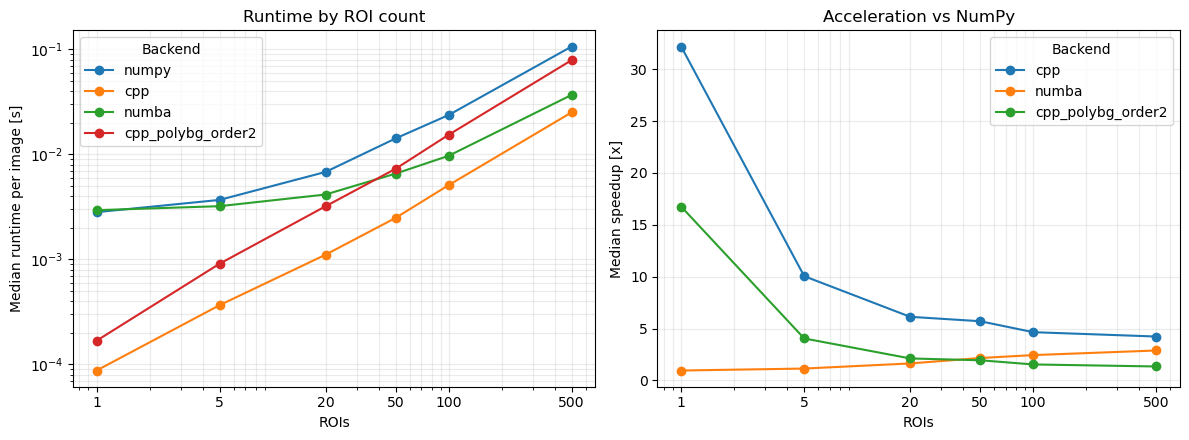
This measures one in-memory image for 1, 5, 20, 50, 100, 500 ROIs with background strips enabled. Median time is reported across five measured repeats after one warmup call per backend and ROI count.
cpp_polybg_order2 uses the C++ fitted-background path with a second-order polynomial fit to the pixels in the four background strips. Its fitted background values are not expected to equal the strip-sum background values, so it is timed alongside the other paths but not validated against NumPy strip-background counters.
[9]:
ROI_COUNTS = (1, 5, 20, 50, 100, 500)
roi_results = []

for n_rois in ROI_COUNTS:
    args = make_args(rois=n_rois)
    image, background, mask, correction, rois = roi_bench.make_inputs(args)
    bg_counts = background_pixel_counts(mask, rois)
    bg_total_px = int(bg_counts.sum())
    bg_median_px = float(np.median(bg_counts))
    bg_min_px = int(bg_counts.min())
    bg_max_px = int(bg_counts.max())

    reference = None
    row_results = {}
    for name, func in backends.items():
        result = roi_bench.benchmark_backend(
            name,
            func,
            image,
            background,
            mask,
            correction,
            rois,
            repeats=args.repeats,
        )
        if name == "numpy":
            reference = result["counters"]
        else:
            roi_bench.check_results(reference, result["counters"], f"{name} {n_rois} ROIs")
        counters = result.pop("counters")
        result["counter_checksum"] = float(sum(np.nansum(counter) for counter in counters))
        row_results[name] = result

    polybg_result = benchmark_polybg_backend(
        polybg_func,
        image,
        mask,
        correction,
        rois,
        repeats=args.repeats,
    )
    polybg_counters = polybg_result.pop("counters")
    polybg_result["counter_checksum"] = float(sum(np.nansum(counter) for counter in polybg_counters))
    row_results[POLYBG_BACKEND] = polybg_result

    numpy_median = row_results["numpy"]["median_seconds"]
    for name, result in row_results.items():
        roi_results.append(
            {
                "rois": n_rois,
                "backend": name,
                "median_s": result["median_seconds"],
                "min_s": result["min_seconds"],
                "warmup_s": result["warmup_seconds"],
                "speedup_vs_numpy": numpy_median / result["median_seconds"],
                "bg_total_px": bg_total_px,
                "bg_median_px": bg_median_px,
                "bg_min_px": bg_min_px,
                "bg_max_px": bg_max_px,
            }
        )

summary_rows = [
    {
        "rois": row["rois"],
        "backend": row["backend"],
        "bg_total": row["bg_total_px"],
        "bg_median": f"{row['bg_median_px']:.0f}",
        "bg_range": f"{row['bg_min_px']}-{row['bg_max_px']}",
        "median": format_seconds(row["median_s"]).strip(),
        "min": format_seconds(row["min_s"]).strip(),
        "speedup": f"{row['speedup_vs_numpy']:.2f}x",
    }
    for row in roi_results
]
print_table(
    summary_rows,
    (
        ("rois", "ROIs"),
        ("backend", "backend"),
        ("bg_total", "bg px total"),
        ("bg_median", "bg px/ROI median"),
        ("bg_range", "bg px/ROI range"),
        ("median", "median"),
        ("min", "min"),
        ("speedup", "speedup"),
    ),
)
ROIs           backend bg px total bg px/ROI median bg px/ROI range    median       min speedup
   1             numpy        5173             5173       5173-5173   2.82 ms   2.71 ms   1.00x
   1               cpp        5173             5173       5173-5173   87.6 us   80.6 us  32.18x
   1             numba        5173             5173       5173-5173   2.94 ms   2.78 ms   0.96x
   1 cpp_polybg_order2        5173             5173       5173-5173  168.3 us  159.5 us  16.75x
   5             numpy       30432             5178       2889-9989   3.69 ms   3.64 ms   1.00x
   5               cpp       30432             5178       2889-9989  366.9 us  347.2 us  10.05x
   5             numba       30432             5178       2889-9989   3.21 ms   3.16 ms   1.15x
   5 cpp_polybg_order2       30432             5178       2889-9989  910.6 us  844.9 us   4.05x
  20             numpy      121378             5765       543-11579   6.81 ms   6.57 ms   1.00x
  20               cpp      121378             5765       543-11579   1.11 ms   1.05 ms   6.13x
  20             numba      121378             5765       543-11579   4.15 ms   4.04 ms   1.64x
  20 cpp_polybg_order2      121378             5765       543-11579   3.21 ms   3.06 ms   2.12x
  50             numpy      284650             5781       544-11879  14.19 ms  12.99 ms   1.00x
  50               cpp      284650             5781       544-11879   2.49 ms   2.38 ms   5.71x
  50             numba      284650             5781       544-11879   6.56 ms   5.89 ms   2.16x
  50 cpp_polybg_order2      284650             5781       544-11879   7.29 ms   7.18 ms   1.95x
 100             numpy      594635             5744       550-14296  23.69 ms  22.63 ms   1.00x
 100               cpp      594635             5744       550-14296   5.09 ms   5.00 ms   4.65x
 100             numba      594635             5744       550-14296   9.69 ms   9.34 ms   2.44x
 100 cpp_polybg_order2      594635             5744       550-14296  15.36 ms  15.16 ms   1.54x
 500             numpy     2915775             5623       550-16127 106.37 ms 102.09 ms   1.00x
 500               cpp     2915775             5623       550-16127  25.13 ms  24.44 ms   4.23x
 500             numba     2915775             5623       550-16127  36.84 ms  36.16 ms   2.89x
 500 cpp_polybg_order2     2915775             5623       550-16127  78.93 ms  75.25 ms   1.35x
ROI Count Results
The runtime plot uses a log y-axis because the NumPy and accelerated paths differ by orders of magnitude for small ROI counts. The speedup plot is normalized to the NumPy median for the same ROI count.
[10]:
from matplotlib import pyplot as plt

fig, axes = plt.subplots(1, 2, figsize=(12, 4.5))
ax_time, ax_speedup = axes
plot_backends = list(backends) + [POLYBG_BACKEND]

for backend in plot_backends:
    rows = [row for row in roi_results if row["backend"] == backend]
    ax_time.plot(
        [row["rois"] for row in rows],
        [row["median_s"] for row in rows],
        marker="o",
        label=backend,
    )
    if backend != "numpy":
        ax_speedup.plot(
            [row["rois"] for row in rows],
            [row["speedup_vs_numpy"] for row in rows],
            marker="o",
            label=backend,
        )

ax_time.set_title("Runtime by ROI count")
ax_time.set_xlabel("ROIs")
ax_time.set_ylabel("Median runtime per image [s]")
ax_time.set_xscale("log")
ax_time.set_yscale("log")
ax_time.set_xticks(ROI_COUNTS)
ax_time.get_xaxis().set_major_formatter(plt.ScalarFormatter())
ax_time.grid(which="both", alpha=0.25)
ax_time.legend(title="Backend")

ax_speedup.set_title("Acceleration vs NumPy")
ax_speedup.set_xlabel("ROIs")
ax_speedup.set_ylabel("Median speedup [x]")
ax_speedup.set_xscale("log")
ax_speedup.set_xticks(ROI_COUNTS)
ax_speedup.get_xaxis().set_major_formatter(plt.ScalarFormatter())
ax_speedup.grid(which="both", alpha=0.25)
ax_speedup.legend(title="Backend")

fig.tight_layout()
Threaded Disk-Image Sweep
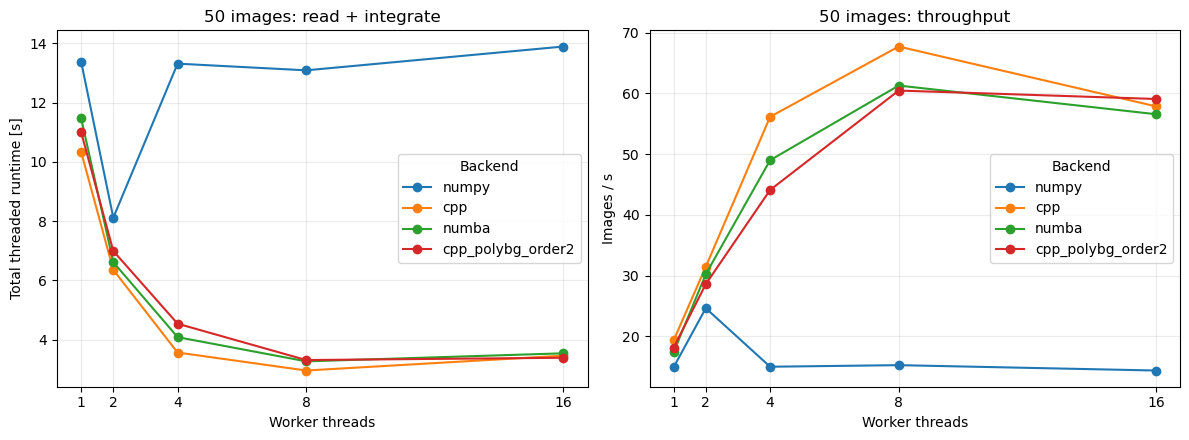
This measures reading 50 synthetic .npy images from disk and integrating each image with 50 ROIs plus background strips. The same serial baseline is reused for each backend, then the workload is repeated with 1, 2, 4, 8 worker threads.
The fitted-background rows use the C++ second-order polynomial path and the same background-strip pixels reported in the table.
[16]:
THREAD_COUNTS = (1, 2, 4, 8, 16)
DISK_IMAGES = 200
THREAD_ROIS = 100
thread_results = []

thread_args = make_args(rois=THREAD_ROIS, disk_images=DISK_IMAGES)
image, background, mask, correction, rois = roi_bench.make_inputs(thread_args)
bg_counts = background_pixel_counts(mask, rois)
thread_bg_total_px = int(bg_counts.sum())
thread_bg_median_px = float(np.median(bg_counts))
thread_bg_min_px = int(bg_counts.min())
thread_bg_max_px = int(bg_counts.max())

with tempfile.TemporaryDirectory() as tmp:
    disk_dir = Path(tmp)
    image_paths = roi_bench.make_disk_images(thread_args, disk_dir)
    print(f"Disk image directory: {disk_dir}")
    print("Disk image format: .npy float64")
    print(f"Background pixels total per image: {thread_bg_total_px}")
    print(
        "Background pixels per ROI: "
        f"median {thread_bg_median_px:.0f}, range {thread_bg_min_px}-{thread_bg_max_px}"
    )

    disk_backend_specs = [(name, func, "strip") for name, func in backends.items()]
    disk_backend_specs.append((POLYBG_BACKEND, polybg_func, "polybg"))

    for backend, func, mode in disk_backend_specs:
        start = time.perf_counter()
        if mode == "polybg":
            serial_counters = [
                process_polybg_disk_image(path, func, mask, correction, rois)
                for path in image_paths
            ]
        else:
            serial_counters = [
                roi_bench.process_disk_image(path, func, background, mask, correction, rois)
                for path in image_paths
            ]
        serial_s = time.perf_counter() - start
        serial_checksum = roi_bench.checksum_counters(serial_counters)

        for threads in THREAD_COUNTS:
            start = time.perf_counter()
            with concurrent.futures.ThreadPoolExecutor(max_workers=threads) as executor:
                if mode == "polybg":
                    futures = [
                        executor.submit(
                            process_polybg_disk_image,
                            path,
                            func,
                            mask,
                            correction,
                            rois,
                        )
                        for path in image_paths
                    ]
                else:
                    futures = [
                        executor.submit(
                            roi_bench.process_disk_image,
                            path,
                            func,
                            background,
                            mask,
                            correction,
                            rois,
                        )
                        for path in image_paths
                    ]
                threaded_counters = [future.result() for future in futures]
            threaded_s = time.perf_counter() - start

            for i, (serial, threaded) in enumerate(zip(serial_counters, threaded_counters, strict=True)):
                if mode == "polybg":
                    for expected, actual in zip(serial, threaded, strict=True):
                        np.testing.assert_allclose(actual, expected, rtol=1e-12, atol=1e-9)
                else:
                    roi_bench.check_results(serial, threaded, f"{backend} threaded image {i}")

            thread_results.append(
                {
                    "backend": backend,
                    "threads": threads,
                    "images": DISK_IMAGES,
                    "rois": THREAD_ROIS,
                    "serial_s": serial_s,
                    "threaded_s": threaded_s,
                    "thread_speedup": serial_s / threaded_s,
                    "threaded_images_per_s": DISK_IMAGES / threaded_s,
                    "bg_total_px": thread_bg_total_px,
                    "bg_median_px": thread_bg_median_px,
                    "bg_min_px": thread_bg_min_px,
                    "bg_max_px": thread_bg_max_px,
                    "serial_checksum": serial_checksum,
                    "threaded_checksum": roi_bench.checksum_counters(threaded_counters),
                }
            )

summary_rows = [
    {
        "backend": row["backend"],
        "threads": row["threads"],
        "bg_total": row["bg_total_px"],
        "bg_median": f"{row['bg_median_px']:.0f}",
        "bg_range": f"{row['bg_min_px']}-{row['bg_max_px']}",
        "serial": format_seconds(row["serial_s"]).strip(),
        "threaded": format_seconds(row["threaded_s"]).strip(),
        "gain": f"{row['thread_speedup']:.2f}x",
        "ips": f"{row['threaded_images_per_s']:.2f}",
    }
    for row in thread_results
]
print_table(
    summary_rows,
    (
        ("backend", "backend"),
        ("threads", "threads"),
        ("bg_total", "bg px total"),
        ("bg_median", "bg px/ROI median"),
        ("bg_range", "bg px/ROI range"),
        ("serial", "serial"),
        ("threaded", "threaded"),
        ("gain", "thread_gain"),
        ("ips", "images/s"),
    ),
)
Disk image directory: C:\Users\timof\AppData\Local\Temp\tmpbt5pkb9f
Disk image format: .npy float64
Background pixels total per image: 594635
Background pixels per ROI: median 5744, range 550-14296
          backend threads bg px total bg px/ROI median bg px/ROI range   serial threaded thread_gain images/s
            numpy       1      594635             5744       550-14296 15.310 s 13.386 s       1.14x    14.94
            numpy       2      594635             5744       550-14296 15.310 s  8.113 s       1.89x    24.65
            numpy       4      594635             5744       550-14296 15.310 s 13.318 s       1.15x    15.02
            numpy       8      594635             5744       550-14296 15.310 s 13.093 s       1.17x    15.28
            numpy      16      594635             5744       550-14296 15.310 s 13.896 s       1.10x    14.39
              cpp       1      594635             5744       550-14296  9.366 s 10.337 s       0.91x    19.35
              cpp       2      594635             5744       550-14296  9.366 s  6.354 s       1.47x    31.48
              cpp       4      594635             5744       550-14296  9.366 s  3.562 s       2.63x    56.16
              cpp       8      594635             5744       550-14296  9.366 s  2.953 s       3.17x    67.72
              cpp      16      594635             5744       550-14296  9.366 s  3.455 s       2.71x    57.88
            numba       1      594635             5744       550-14296 11.142 s 11.470 s       0.97x    17.44
            numba       2      594635             5744       550-14296 11.142 s  6.613 s       1.68x    30.24
            numba       4      594635             5744       550-14296 11.142 s  4.081 s       2.73x    49.01
            numba       8      594635             5744       550-14296 11.142 s  3.263 s       3.41x    61.30
            numba      16      594635             5744       550-14296 11.142 s  3.534 s       3.15x    56.59
cpp_polybg_order2       1      594635             5744       550-14296 10.925 s 11.004 s       0.99x    18.17
cpp_polybg_order2       2      594635             5744       550-14296 10.925 s  6.991 s       1.56x    28.61
cpp_polybg_order2       4      594635             5744       550-14296 10.925 s  4.534 s       2.41x    44.11
cpp_polybg_order2       8      594635             5744       550-14296 10.925 s  3.307 s       3.30x    60.48
cpp_polybg_order2      16      594635             5744       550-14296 10.925 s  3.385 s       3.23x    59.09
Threaded Results
The left plot shows end-to-end time for 50 disk-backed images. The right plot shows throughput for the same workload.
[17]:
fig, axes = plt.subplots(1, 2, figsize=(12, 4.5))
ax_time, ax_rate = axes

for backend in plot_backends:
    rows = [row for row in thread_results if row["backend"] == backend]
    ax_time.plot(
        [row["threads"] for row in rows],
        [row["threaded_s"] for row in rows],
        marker="o",
        label=backend,
    )
    ax_rate.plot(
        [row["threads"] for row in rows],
        [row["threaded_images_per_s"] for row in rows],
        marker="o",
        label=backend,
    )

ax_time.set_title("50 images: read + integrate")
ax_time.set_xlabel("Worker threads")
ax_time.set_ylabel("Total threaded runtime [s]")
ax_time.set_xticks(THREAD_COUNTS)
ax_time.grid(alpha=0.25)
ax_time.legend(title="Backend")

ax_rate.set_title("50 images: throughput")
ax_rate.set_xlabel("Worker threads")
ax_rate.set_ylabel("Images / s")
ax_rate.set_xticks(THREAD_COUNTS)
ax_rate.grid(alpha=0.25)
ax_rate.legend(title="Backend")

fig.tight_layout()
[ ]: